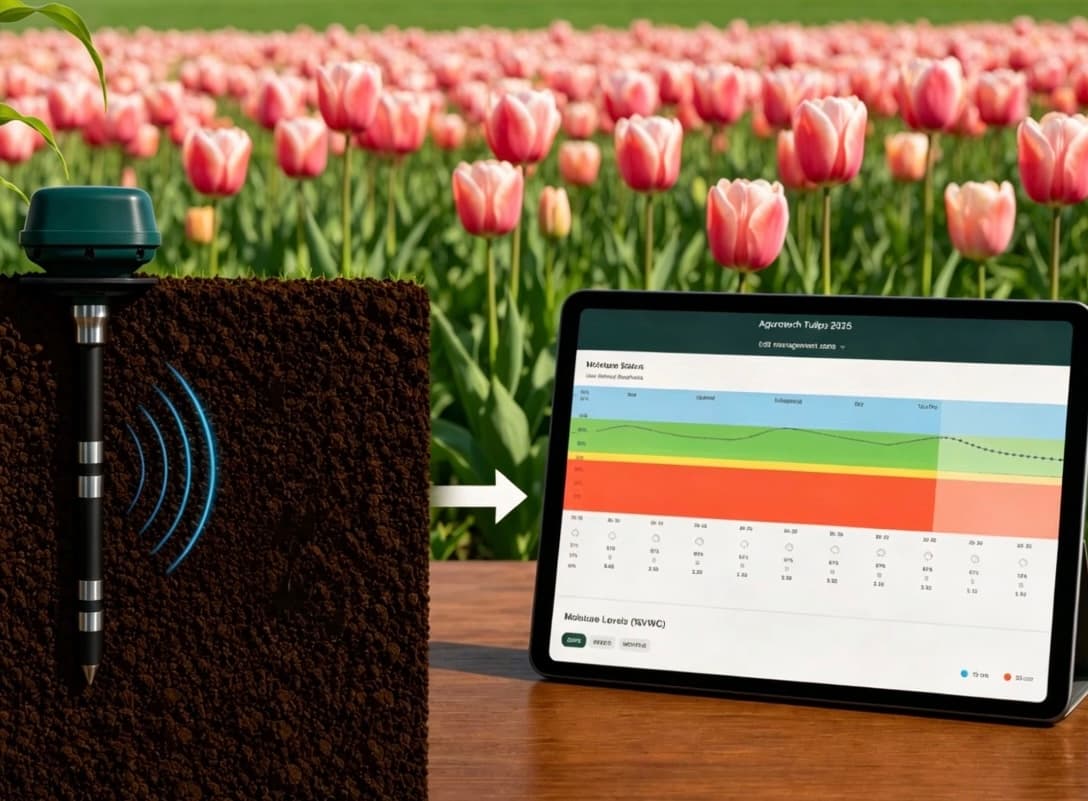
In the previous blog, we argued that reliable soil moisture is built, not just measured.
A VWC value in the field is not a direct observation of water. It is an estimate, produced by a sensor signal, translated through calibration, and corrected for the conditions around the measurement.
That raises the next question:
What exactly needs to be corrected?
This is where EC and temperature become more than extra data points. They help explain whether a change in the sensor signal is really caused by water — or partly by the soil conditions around that water.
To understand why, we need to go one level deeper into the measurement itself.
The sensor does not measure water. It measures electrical behaviour.
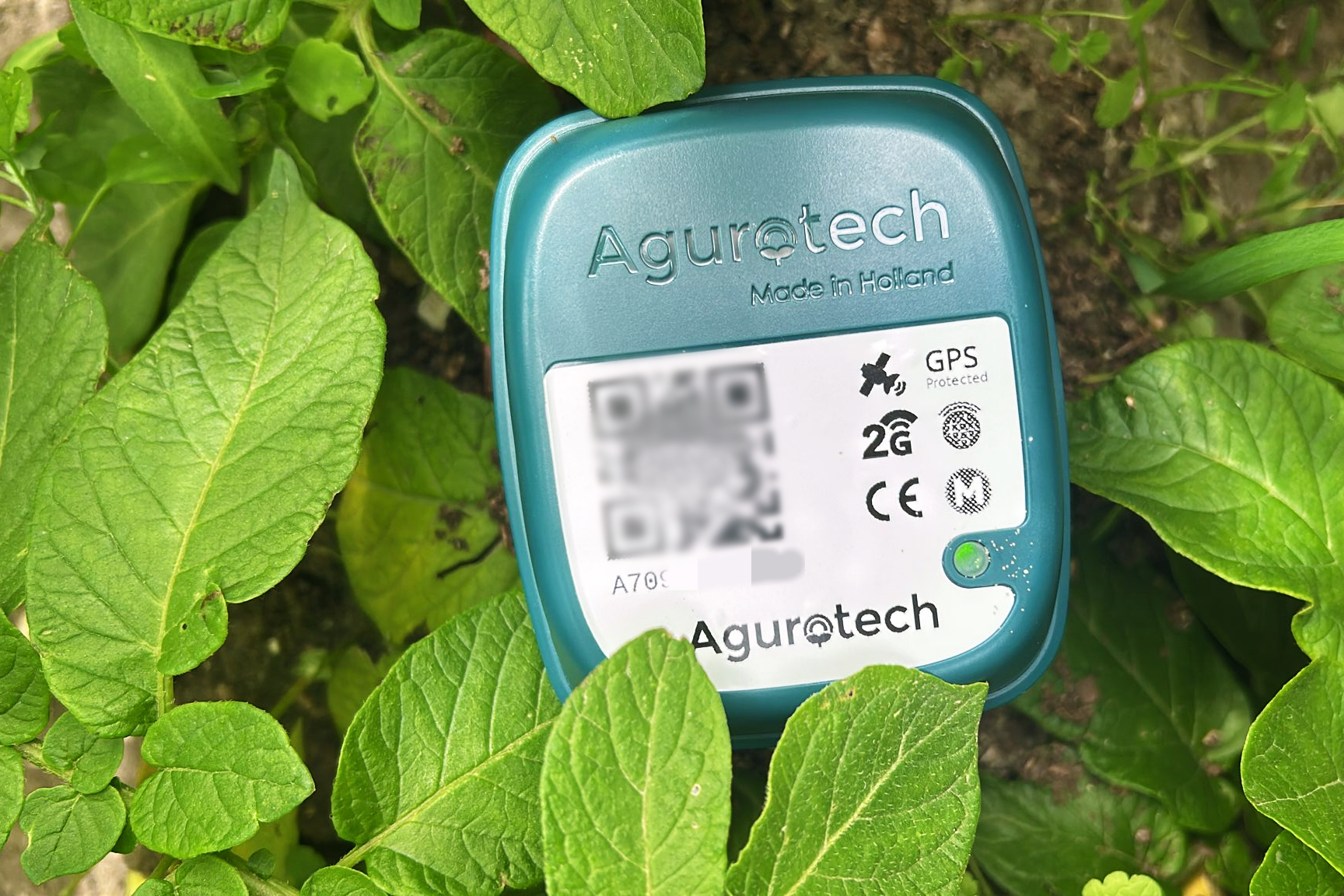
Most real-time soil moisture sensors rely on the same basic principle: water behaves very differently from air and soil particles when exposed to an electrical or electromagnetic signal.
Water has a much higher dielectric response than air or dry mineral soil. That difference is what makes dielectric soil moisture sensing possible. When more water fills the pores, the electrical behaviour of the soil changes. The sensor reads that change and translates it into volumetric water content.
This is the foundation behind many TDR, FDR and capacitance-based sensors. It is also the logic behind one of the most important references in soil moisture measurement: the Topp equation. Topp and his colleagues showed that, for many mineral soils, there is a strong relationship between apparent dielectric permittivity and volumetric water content.
That was a breakthrough.
But it was never the end of the story. Because the soil signal is not controlled by water alone.
Soil texture, bulk density, clay content, organic matter, salt concentration and temperature can all influence the relationship between the electrical signal and the final VWC estimate. In other words: the calibration curve is powerful, but it is not magic. It has a range in which it performs well, and conditions under which it needs support.
That support comes from measuring what else is happening in the soil.
Why salt can disturb a moisture estimate
Salts matter because they change how conductive the soil solution is.
When dissolved salts or ions increase, the soil solution conducts electricity more easily. For a sensor that infers moisture from an electrical signal, this can influence the reading. In simple terms: part of the signal may look like “more water,” when part of it is actually “more conductivity.”
This is especially relevant in salt-affected soils, drip-irrigated zones, coastal areas, fields using brackish irrigation water, or situations where fertilisers and salts move through the profile.
The important point is not that soil moisture sensors fail in these situations. The point is that the measurement problem becomes more complex.
A high-quality system must separate two things that can happen at the same time:
- The soil may become wetter or drier.
- The soil solution may become more or less conductive.
If the system only measures the moisture signal, it has limited information to separate those effects. If it also measures EC, it gains a second view of the soil condition. That makes correction possible. This is why EC is not only agronomic context. It is part of the measurement logic.
Bulk EC is not the same as root-zone salinity
There is another subtle point that matters.
When a sensor measures EC in the soil, it usually measures bulk EC: the electrical conductivity of the soil as a whole. That value is influenced by the salt concentration in the soil water, but also by how much water is present, how connected the pores are, and what the soil structure looks like.
This creates a common interpretation problem.
During drying, the salt concentration in the remaining pore water can increase, because there is less water diluting the salts. But at the same time, bulk EC may not simply rise, because there is also less connected water available to conduct electricity through the soil. So bulk EC alone does not automatically tell you how salty the water around the roots is. That is why the combination of VWC and EC is so important.
When you know both the water content and the bulk electrical conductivity, you can start translating the raw EC signal into something more agronomically meaningful: the salinity of the soil solution, or a saturation-based EC value that relates better to crop response.
This is the logic behind models such as Hilhorst’s. The point is not just to show EC as a separate graph. The point is to use moisture and conductivity together so the system can understand the soil solution more accurately. That is where a sensor becomes more than a meter. It becomes a translator.
Frequency matters
Not all electrical signals behave the same way in soil.
At lower frequencies, measurements are generally more sensitive to conductivity effects. Salts and ions have more influence on the signal, which can make it harder to isolate moisture. At higher frequencies, the measurement can become less sensitive to conductivity effects, which is one reason high-frequency dielectric methods are useful for VWC.
But “less sensitive” does not mean “not sensitive at all.” This is the engineering trade-off.
A high-frequency FDR signal can be very effective for measuring VWC, because it focuses more strongly on the dielectric response associated with water. But if salinity becomes high enough, or if soil conditions vary strongly, conductivity can still influence the interpretation. So the answer is not simply to choose one frequency and ignore the rest.
The better approach is to design a system that understands which signal is meant to answer which question.
A high-frequency signal can support the VWC estimate.
A lower-frequency or separate conductivity measurement can support EC interpretation.
Temperature measurement helps stabilise both.
Together, those signals allow the system to separate water, salt and temperature effects more intelligently than a moisture-only reading can.
This is where sensor design becomes product quality.
The challenge is not just adding an EC sensor next to a VWC sensor. The challenge is signal separation, shielding, filtering, calibration and interpretation, so that each measurement strengthens the others instead of adding noise.
Temperature is not a simple correction
Temperature sounds easier than EC. Measure the temperature. Correct the reading. Done.
In practice, it is more complicated.
Temperature affects the dielectric behaviour of water, but soil is not just free water. It contains bound water, clay surfaces, air pockets, dissolved ions and organic material. These can respond differently as temperature changes.
That means the temperature effect is not always a simple straight line.
In some soils and moisture ranges, warming can make the apparent permittivity move in one direction. In other conditions, the response can be weaker or even different. Research on soil capacitance and dielectric sensors has shown that temperature effects depend on soil composition and structure, not just the temperature itself.
For growers, this matters because temperature creates patterns.
A sensor curve may show a small daily rhythm: up and down between morning and afternoon. If the system does not account for temperature, part of that rhythm can be mistaken for a real moisture trend.
In one published analysis of a low-cost capacitance soil moisture sensor, a 10°C temperature change affected measured water content by about 0.02 cm³/cm³. That may sound small, but near an irrigation threshold it can be enough to influence how confidently a grower reads the trend.
That does not mean growers should stare at temperature graphs all day.
It means the system should use temperature to stabilise the VWC estimate before it becomes advice.
What EC and temperature make possible
Once VWC, EC and temperature are measured together, the system can do much more than report three separate lines.
It can ask better questions.
- Did the soil really get wetter, or did conductivity change?
- Did irrigation reach the root zone, or only change the upper layer?
- Is the crop using water, or is the curve partly moving with temperature?
- Is EC changing because salts are concentrating, or because water content changed?
- Is a rise in EC at depth after rainfall a possible sign of leaching?
These are not academic questions. They affect real decisions.
For example, after fertilisation and irrigation, VWC and EC may rise together. A moisture-only system sees mainly the water response. A combined system can also see that dissolved ions are moving through the soil.
After heavy rainfall, EC in the upper layer may drop while EC deeper in the profile increases. Together with VWC and weather data, that pattern can point to vertical movement of salts or nutrients.
In a salt-affected field, two zones may show similar moisture levels, but very different conductivity behaviour. For the crop, that matters. The same amount of water may not be equally easy to take up if the soil solution is more saline.
This is the step from “how much water is there?” to “what kind of root-zone environment is the crop experiencing?”
The grower should not see the complexity
The grower does not need to manage all of this manually.
A grower should not have to think about the Topp equation, dielectric loss, pore-water EC, bulk EC, frequency response or temperature coefficients before deciding where to irrigate.
That work belongs inside the system. The grower needs a clear answer:
Is the field still in range? Is the trend reliable? Can irrigation wait? Is stress building? Did the previous round work? Is something unusual happening in the root zone?
The deeper physics only matters because it makes those answers better.
That is the role of EC and temperature. Not to create more dashboard complexity, but to improve the quality of the moisture information that reaches the grower.
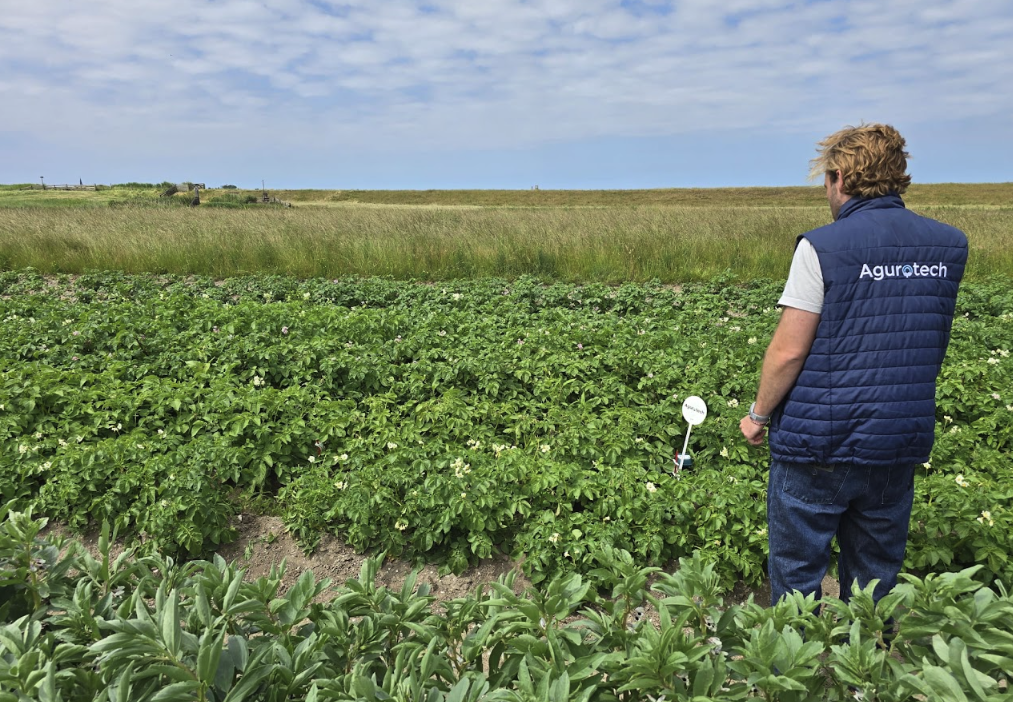
From moisture data to root-zone intelligence
At Agurotech, this is how we think about the next generation of soil sensing.
VWC remains the foundation of irrigation advice. But the VWC estimate becomes stronger when the system also measures the factors that influence it.
That means combining high-frequency FDR for moisture with independent EC and temperature measurements. It means:
- Testing the sensor under different moisture, salinity and temperature conditions.
- Calibrating VWC across EC levels instead of assuming one curve will hold everywhere.
- Validating the measurement in real fields, including brackish and saline conditions.
- Translating those corrected measurements into something growers can actually use.
The output should not be a physics lesson. It should be reliable root-zone insight.
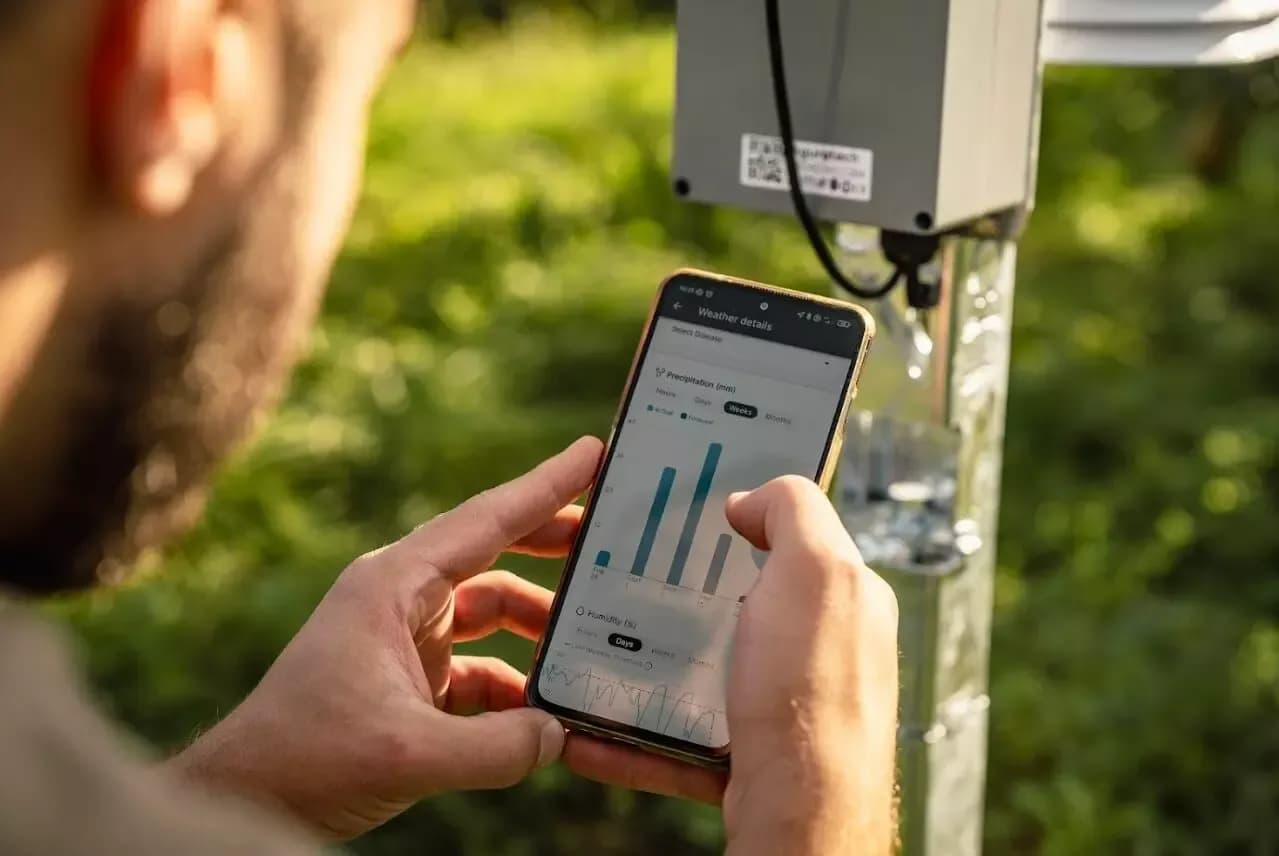
A grower should be able to open the app and understand whether the soil is drying, whether irrigation reached the right depth, whether salts are accumulating, whether leaching may be occurring, and whether the next irrigation decision can wait.
That is where EC and temperature earn their place. Not as extra features.
As part of making VWC reliable.
The future of smart irrigation is not moisture-only. It is corrected, contextualised root-zone intelligence.
.jpg&w=3840&q=75)