It often starts below the surface, out of sight, in the root zone. By the time a grower sees yellowing, uneven growth or disappointing quality, the real process may already have been building for weeks. That is what makes salinity so difficult to manage. The problem is not only that salt affects crops. The problem is that growers often see it too late. And if you see it too late, your options are already limited.
Salinity is becoming a management problem
For a long time, salinity was treated as something that belonged mainly to coastal regions, specific polders or extreme situations.
That view is becoming outdated.
In the Netherlands, salinity is increasingly linked to a broader pressure on water and soil. Dry periods are becoming more important. Freshwater availability is under pressure. In parts of the country, brackish groundwater sits closer to the root zone than many people realise. Irrigation becomes more important in dry years, but the quality of that irrigation water is not always guaranteed.
Salinity is not only about seawater entering the land. It is about the movement of water and dissolved salts through the entire soil profile.
During dry periods, salts can concentrate.
• With brackish seepage, salts can move upwards.
• With irrigation, salts can be added or redistributed.
• With rainfall, salts and nutrients can move downwards.
• With poor drainage, they can remain in the wrong place for too long.
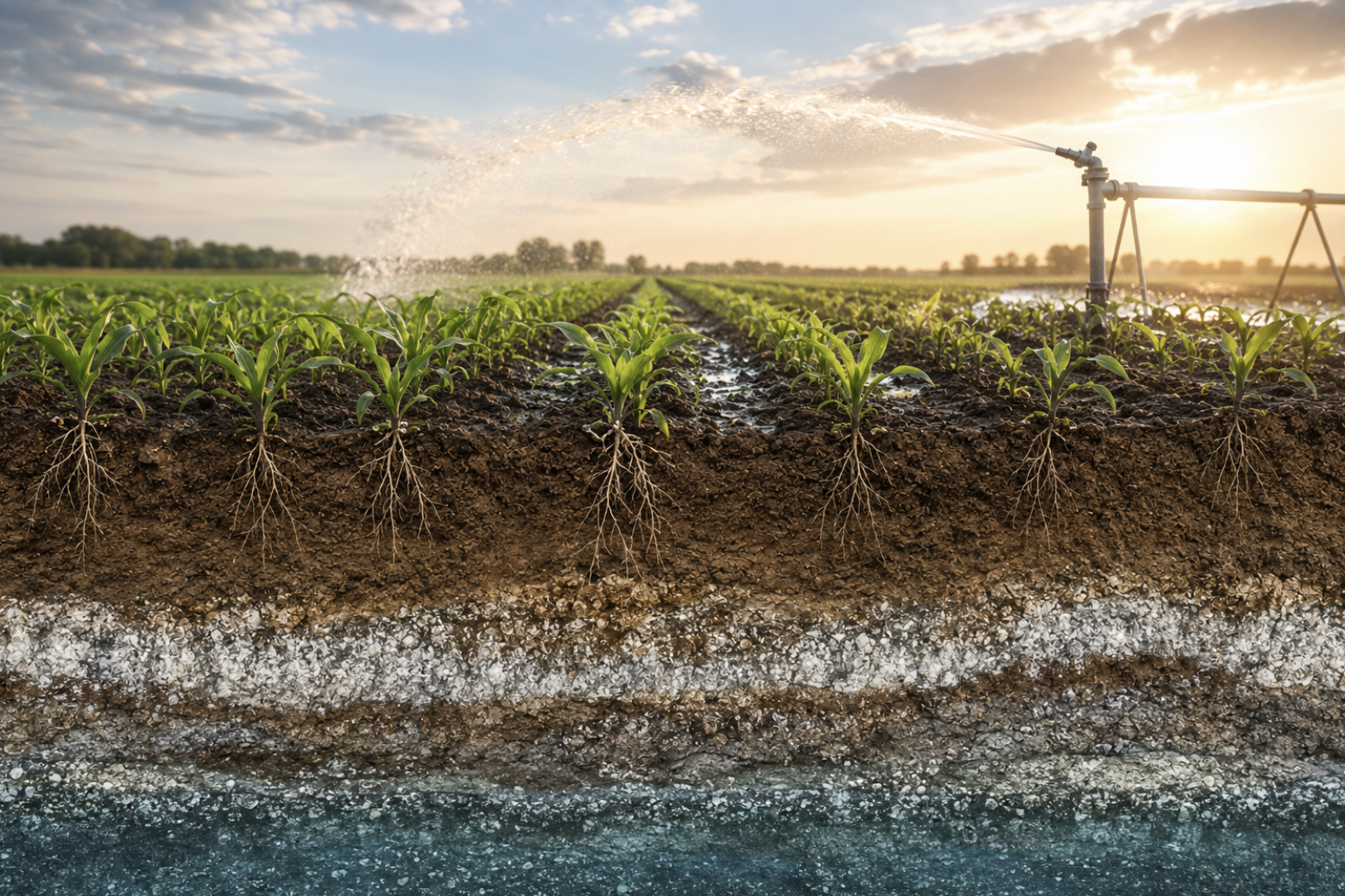
For growers, this creates a practical problem. The crop may be under pressure before the symptoms are visible. The field may still contain water, while the plant is already struggling to take it up. And the right action depends on where the salts are, how fast they are moving, which crop is growing, and whether there is still time to intervene.
That makes salinity not only a soil problem. It is a timing problem.
The crop feels more than moisture
A field can contain water and still create stress.
That sounds contradictory, but for the crop it is very real.
When salt concentration in the soil water increases, the plant has to work harder to take up water. The soil may not be physically dry, but the water becomes less available to the crop. From the plant’s perspective, there is a difference between water being present and water being usable.
This is why looking only at moisture can be misleading.
A grower may see that the root zone still contains water. A moisture graph may show that VWC is not yet critically low. But if EC is rising, the crop may already be experiencing a different kind of pressure.
That pressure can become economically relevant sooner than many expect. Agronomic salt-tolerance research shows that potato, for example, has a salinity threshold around ECe 1.7 dS/m and loses roughly 12% of yield for every additional dS/m above that threshold. In practice, that means salinity levels that may still sound moderate can already translate into meaningful yield loss.
That number matters because it makes salinity less abstract.
It shows why early insight is valuable.
• Not after the crop turns yellow.
• Not after quality drops.
• Not after the yield loss is already visible.
But while there is still room to adjust irrigation, drainage, fertilisation or field planning.
Why snapshots are not enough
Electrical conductivity, or EC, gives insight into the concentration of dissolved salts and ions in the soil solution.
Traditionally, EC is often measured through hand measurements, soil samples or lab analysis. Those methods can be useful, especially for reference and calibration. But they are snapshots. They tell you something about one moment, one place and often one depth.
Salinity does not behave like a snapshot.
Salts move with water. Nutrients move with water. After rainfall, irrigation or fertilisation, the situation in the root zone can change quickly. What matters is not only the EC value today, but the direction of change.
A measurement on Monday may not explain what happened after irrigation on Tuesday. A sample from the top layer may miss what is happening deeper in the active root zone. A single value may confirm that salinity exists, but not whether the risk is increasing or decreasing.
That is why realtime EC matters. Not because growers need another graph. Because timing matters. A warning after the crop shows stress is not really a warning. It is an explanation after the fact.
Depth changes the story
Salinity is not evenly distributed through the soil.
The upper layer can look manageable while deeper layers are changing. Or the topsoil can show temporary salt concentration that does not yet reflect the main root zone. In some fields, salt comes from below. In others, it accumulates around irrigation zones or moves after rainfall.
This is why depth matters.
A single EC value from one point cannot explain the full situation. It may tell you that something is happening, but not where it is happening or whether it affects the crop.
For irrigation and salinity management, the vertical profile is often the story.
At shallow depth, the signal may show the effect of recent rain, irrigation or evaporation.
In the active root zone, it shows what the crop is actually growing in.
At deeper levels, it can reveal whether salts or nutrients are moving downwards and leaving the zone where the crop can use them.
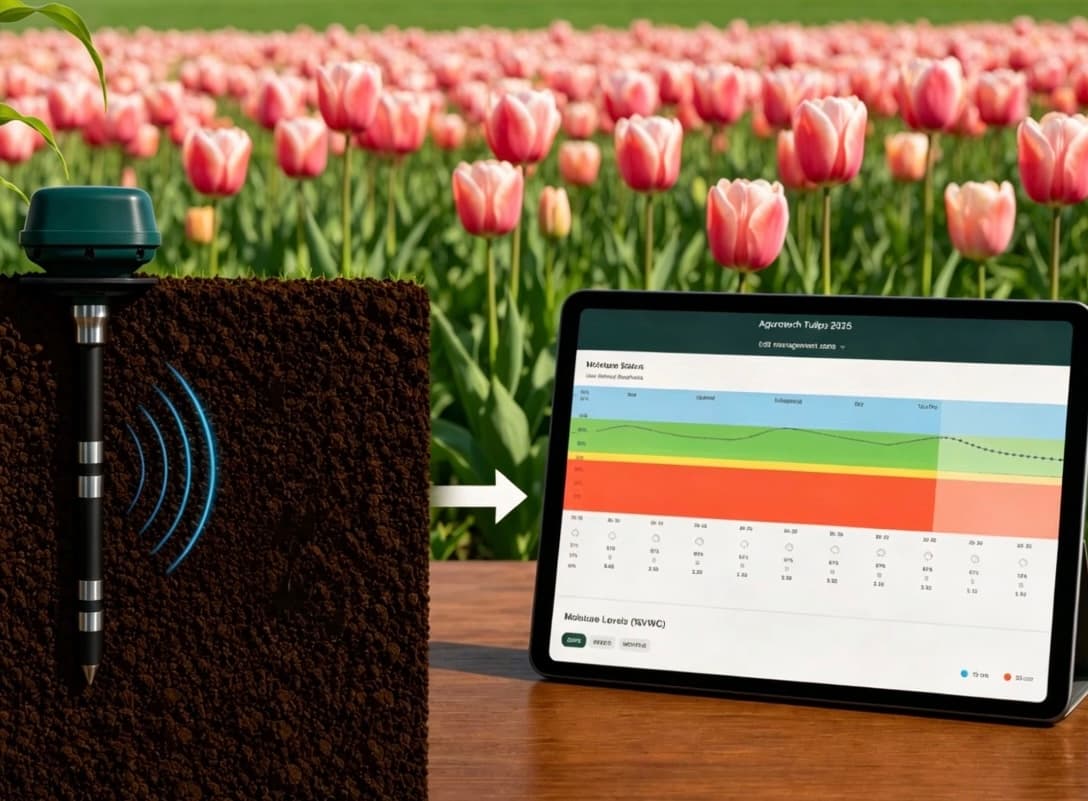
This is one of the strongest arguments for measuring EC, VWC and temperature at multiple depths.
It turns a single measurement into a picture of movement.
And movement is what growers need to understand.
Measuring is not the same as understanding
Realtime EC is powerful, but EC on its own is still not enough.
A raw EC value needs to be interpreted together with moisture, temperature, soil type, depth, crop and growth stage. The same value can mean something different in wet soil than in dry soil. It can mean something different for potatoes than for grassland. It can be more urgent early in crop development than close to harvest.
This is where many systems stop too early.
They show data.
But growers do not need data for its own sake.
They need to know what the data means.
From EC to action
The real value of salinity monitoring is not the measurement itself.
It is the decision it supports.
If EC is rising in the root zone, what should happen next? The answer is rarely simple. One grower may need to irrigate earlier to prevent a salt peak. Another may need to avoid pushing salts or nutrients deeper at the wrong moment. Another may need to check drainage, adjust fertilisation, or simply watch whether the next rainfall event changes the profile.
The right action depends on the crop, soil, water source, weather forecast, field history and growth stage.
That is exactly why realtime soil monitoring has to become decision support.
A useful salinity warning should not only say:
“EC is high.”
It should help explain whether the value is high for this crop, whether the risk is in the active root zone, whether the trend is moving in the wrong direction, and whether there is still time to respond.
The goal is not to automate the grower out of the decision.
The goal is to give the grower earlier, clearer and more defensible information.
The grower’s input is part of the system
A salinity system cannot be built from technology alone.
• The sensor can measure.
• The model can translate.
• The app can warn.
But the grower knows when a warning is useful.
That is why practice validation matters. Not as a final checkbox, but as part of the product.
A warning only has value if it arrives at the right moment. An advice only works if it fits the farm. A dashboard only helps if it reduces complexity instead of adding to it.
For one grower, a useful alert may be an early signal to check irrigation water. For another, it may be a warning that salt is moving into the root zone. For another, it may be confirmation that rainfall has pushed EC down far enough to safely wait.
The technology can be built by engineers.
But whether it works in practice has to be learned with growers.
From hidden risk to practical action
Salinity will become a more important part of crop management in the coming years.
Not everywhere in the same way.
Not in every field at the same speed.
But increasingly often, growers will need to understand not only how much water is in the soil, but what that water carries with it.
Salt.
Nutrients.
Risk.
The opportunity to act.
That is why the next generation of soil monitoring cannot stop at moisture alone. It has to show the root zone as a dynamic system: water moving, salts concentrating or diluting, nutrients staying available or leaching away, and crops responding differently depending on stage and sensitivity.
The future is not a dashboard full of disconnected measurements.
It is one clear picture of what is happening below the surface.
Because the real problem with salinity is not only that it happens.
It is that growers often see it too late.
And the real value of realtime root-zone insight is simple:
See it earlier.
Understand it better.
Act with more confidence.
.jpg&w=3840&q=75)