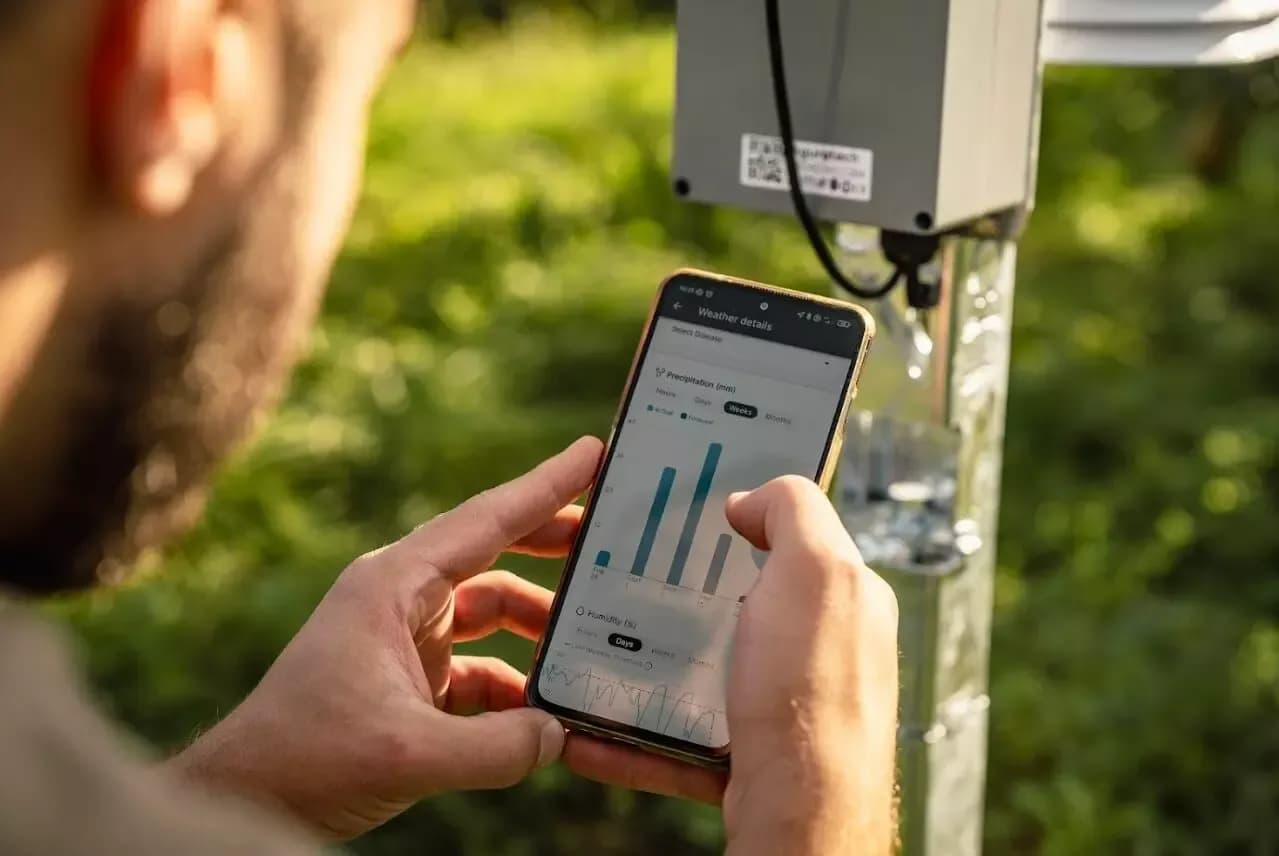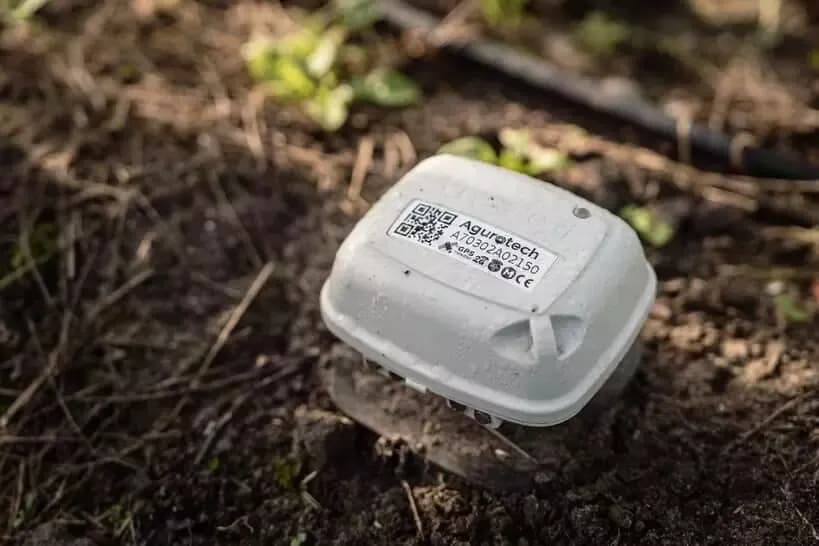
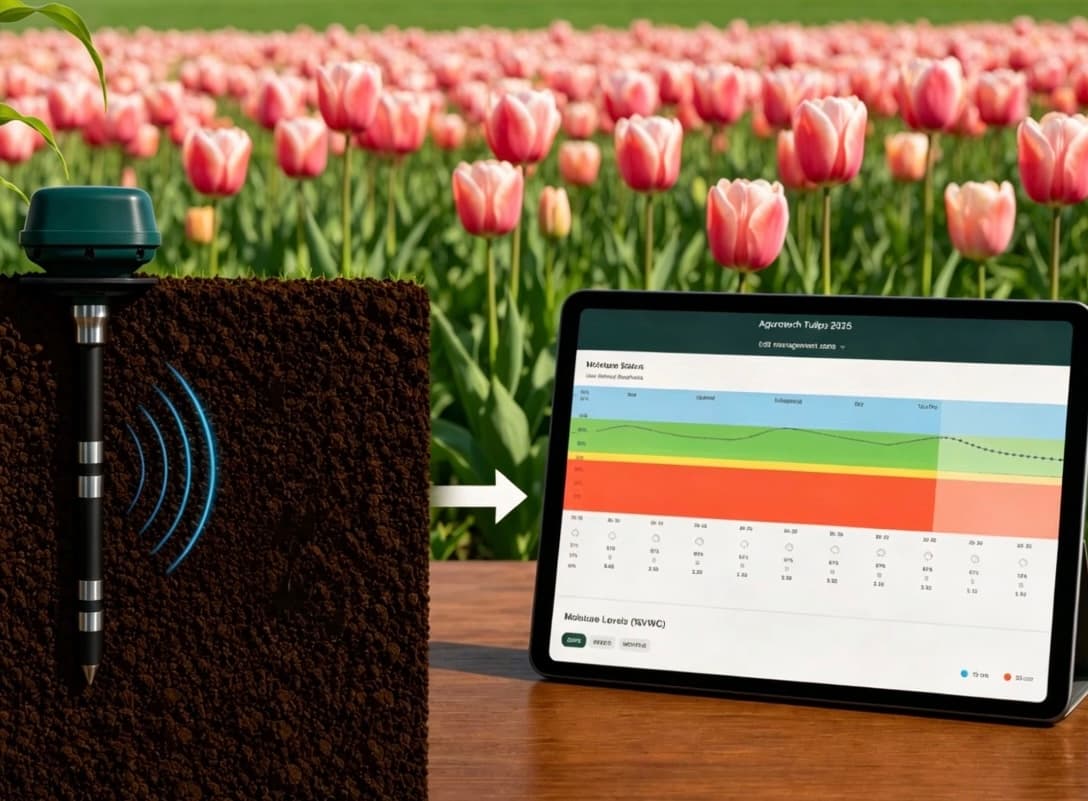
For irrigation, one number often gets most of the attention: Volumetric water content.
VWC tells us how much water is present in a given volume of soil. It is one of the most important measurements in irrigation management. It helps growers understand whether a field is drying out, whether irrigation can wait, or whether action is needed. But reliable soil moisture data does not come from a number alone.It comes from how that number is produced.
That is an important distinction. Because in the field, VWC is not as simple as it may sound. A soil moisture sensor does not simply “see” water in isolation. It measures a signal from a complex soil-water-air system, and that signal has to be translated into a meaningful moisture value.
That is where good technology makes the difference.Not by making irrigation more complicated, but by doing the difficult work in the background: sensor design, calibration, correction, validation and interpretation.
Water content is not a fixed property of soil
Soil has properties that are relatively stable.
- Texture.
- Bulk density.
- Organic matter.
- Structure.
- Mineral composition.
The water content is different.
Water content is not an intrinsic, fixed property of the soil itself. It is a changing state of the soil-water-air system. The same soil can be dry after a warm week, wetter after irrigation, warmer in the afternoon, more saline in one part of the root zone, or less conductive after heavy rainfall.
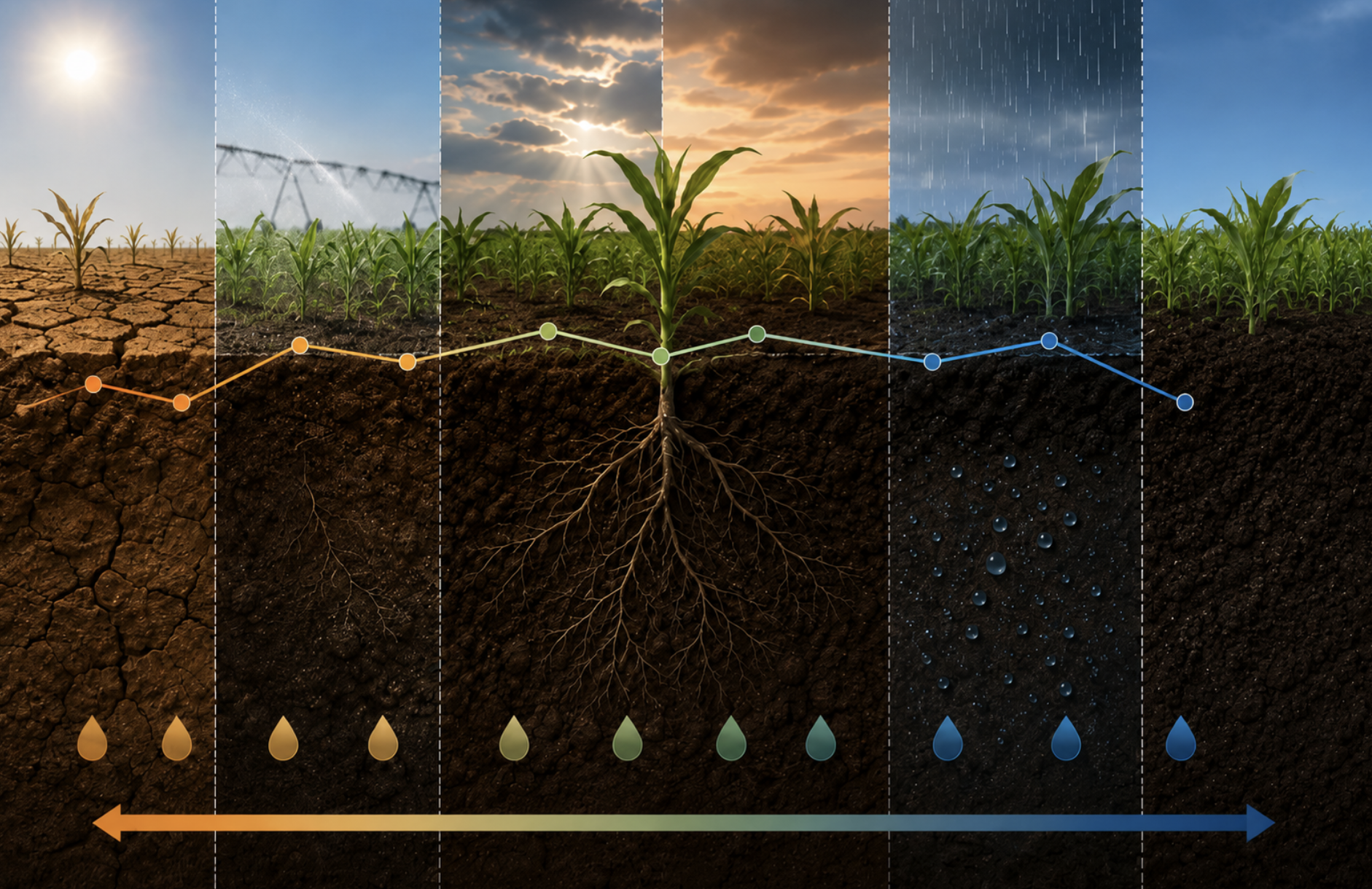
That means “soil moisture” is always a moment-in-time condition.It depends on what happened before: rain, irrigation, crop uptake, drainage, evaporation, fertilisation, temperature and soil structure.
For growers, this is exactly why real-time soil data is so valuable. It shows what is happening below the surface, where water availability cannot always be judged by looking at the crop or feeling the topsoil.
But it also means that reliable soil moisture measurement requires more than simply placing a sensor in the ground.It requires a system that understands the conditions around the measurement.
Most field sensors estimate VWC
In a laboratory, water content can be determined by taking a soil sample, weighing it, drying it, and weighing it again. That gives a strong reference measurement, but it is slow, destructive and not practical for daily irrigation decisions.
A grower cannot take soil samples from every field, every depth, every morning.
Real-time field sensors therefore work differently.
They measure how the soil responds to an electrical signal. From that response, the system estimates VWC using a calibration curve.
That does not make the measurement weak. It simply means the quality of the final VWC value depends on the quality of the system behind it.
The sensor has to generate a stable signal. The calibration has to translate that signal correctly. The system has to recognise when soil conditions may influence the estimate. And the software has to turn the corrected measurement into advice that growers can use.
That is why a reliable VWC is built in layers.
Reliable soil moisture measurement starts with sensor design.
The first layer is hardware.
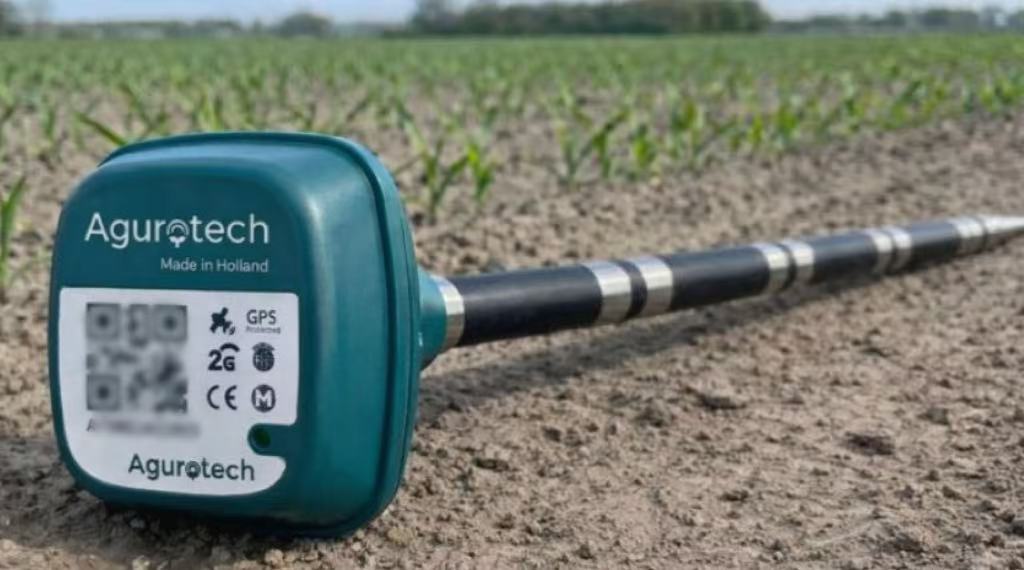
In the field, a sensor has to operate under changing and sometimes harsh conditions. Soil becomes wet and dry. Temperatures shift. Roots grow. Salts and nutrients move. Irrigation water changes the local environment. Heavy rainfall can alter the profile within hours.
A reliable system has to be designed for that reality. It needs stable electronics, good contact with the soil, strong signal quality and protection against noise and interference. It also needs to keep measuring consistently over time.
This is the part growers should not have to think about every day. But it is exactly where trust begins.
A moisture value shown in an app may look simple. Behind it sits the engineering required to make that number meaningful.
Calibration turns a signal into a moisture value
The second layer is calibration.
A sensor signal is not yet an irrigation decision. It first has to be translated into VWC.
That translation is done through calibration: the relationship between the raw signal and the moisture value shown to the grower.
Good calibration is not a formality. It is the heart of the measurement.
If the calibration is strong, the VWC estimate becomes more reliable. If the calibration is too narrow, the same sensor can perform well under one condition and less well under another.
This matters because fields are not uniform. A calibration that works in a clean, stable setting must also hold up in real soils, across different moisture levels, different soil types, different temperatures and different salt concentrations.
That is why the quality of the moisture value depends not only on the sensor, but on the calibration behind it.
Correction protects the measurement
The third layer is correction.
Soil does not only contain water. It contains dissolved salts, nutrients, air, organic material, minerals and roots. The electrical behaviour of that soil-water mixture is influenced by more than moisture alone.
This matters because most real-time soil moisture sensors estimate VWC from an electrical response.
When dissolved salts increase, the soil solution becomes more conductive. A sensor that infers moisture from an electrical signal can read part of that change as water rather than salt, unless it measures EC and corrects for it.
The level of sensitivity depends on the sensor design, frequency and calibration. But the principle matters: if the conditions around the measurement change, the interpretation of the VWC signal may need to change with them.
Temperature can create a similar issue. As soil warms and cools through the day, the electrical response can shift even when very little water has actually moved. A moisture curve may appear to rise or fall slightly on a daily rhythm, while the real change in water content is much smaller.
That is why EC and temperature are not just extra graphs.
They help the system understand the conditions around the VWC estimate. If EC rises, the system can account for the effect of higher conductivity. If temperature changes, the system can compensate for that influence. The result is not more complexity for the grower, but a moisture value that is easier to trust.
This matters most near the decision boundary. On many irrigation dashboards, a difference of only 2–3 percentage points in VWC can change how close a field appears to its lower threshold. That can influence whether a grower decides to irrigate today or wait another day.
Imagine a grower managing a field with a salt-affected patch, a drip zone where salts have built up, or irrigation water with a higher salt content. Two parts of the field may contain similar amounts of water, but one part has a more conductive soil solution. Without correction, the wetter-looking reading may partly reflect salinity rather than water. With EC and temperature measured alongside VWC, the system has the information needed to interpret the signal more carefully before it becomes irrigation advice.
That is the real purpose of correction: not to add more data, but to protect the meaning of the moisture number.
Validation proves it works in the field
The fourth layer is validation.
A sensor has to do more than perform in a controlled environment. It has to make sense in the field.
• Does the sensor respond after irrigation?
• Does it show rainfall reaching the right depth?
• Does the curve decline when the crop is actively using water?
• Does the data match what the grower sees when digging?
• Does it behave logically across different soils and seasons?
This is where technology earns trust.
Growers do not adopt smart irrigation because the science sounds convincing. They adopt it when the data helps them make better decisions in real conditions.
When the field looks dry at the surface but the root zone still contains water, the data should show that. When irrigation does not reach deep enough, the data should reveal that. When one field can wait and another cannot, the system should help explain why.
That is what turns measurement into confidence.
Interpretation turns data into decisions
The final layer is interpretation.
Growers do not need raw complexity. They need clarity. A dashboard full of numbers is not enough. The system has to translate corrected soil data into practical insight:
Is the field still within range? Is it moving towards stress? Can irrigation wait? Which field should be prioritised? Did the previous irrigation round have the intended effect?
This is where soil data becomes decision support.
The grower remains in control. Experience still matters. Field checks still matter. Capacity, labour, crop stage and weather still matter.
But corrected and validated soil data makes those decisions easier to stand behind.
It reduces doubt. It helps growers wait with confidence. It helps them act before stress becomes visible. And it helps them use water more precisely.
The future is not just more sensors
The next phase of smart irrigation will not be won by producing more moisture numbers. It will be won by producing moisture information growers can trust.
That means understanding how VWC is estimated. It means measuring the factors that influence the estimate. It means correcting the signal, validating it in the field, and translating it into advice that fits the reality of farming.
At Agurotech, this is how we think about soil moisture. Not as a standalone number. Not as a graph for the sake of a graph. But as the foundation for reliable irrigation decisions.
Because the real value is not the number itself. It is the confidence behind the decision.
• Can this field wait?
• Did the irrigation reach the root zone?
• Is the crop moving toward stress?
• Is the moisture trend real?
When growers can trust the number behind those questions, data becomes useful. It helps them act earlier when needed, wait when waiting is safe, and explain decisions long after they were made.
That is where smart irrigation is heading: not toward more complexity, but toward better-built data that gives growers confidence in the field.
.jpg&w=3840&q=75)